Posted by: Sand Squiggles -- Richard Modlin's Blog | May 29, 2011

Alabama Writers’ Conclave 2011

Alabama Writers’ Conclave Scheduled for Huntsville, AL

The Alabama Writers’ Conclave, considered one of the oldest continuously active writers’ society in the United States, is expected to draw 80-100 attendees July 15-17 to its Annual Meeting.  The Tranquillity Base Marriott Hotel, next to the Space and Rocket Center, will serve as host during the three-day event. 

            The hallmarks of the AWC are to provide and share information, furnish practical advice to writers, nurture aspiring writers, and support the writing arts by assisting in developing ideas and providing honing skills through the venue of an annual conference, writing contest, manuscript critiques, newsletters, and the publication of contest winners’ entrees in the online journal, The Alaticom. 

            Although many states will be represented during the event, members mainly hail from the State of Alabama.  Members include fiction and non-fiction writers, novelists and short story writers, poets, writers of business and scientific works, freelance journalists, romance writers, publishers, patrons and teachers.

            Scheduled events begin with a Friday evening reception. Writing workshops begin at 8:30 am Saturday and continue through the afternoon. Topping off the evening will be the Grace Gravlee Awards Banquet and keynote presentation by the noted Writer-in-Residence.  Sunday attendees can expect morning workshops and the annual member business meeting during which door prizes will be given.

            Featured workshop faculty include Dr. Sue Brannan Walker, Alabama State Poet Laureate (Poetry), Jim Minick (Memoir), Jenny Ivey (Nonfiction), Chris Roerden (Editing & Fiction), and Rabbi Rami Shapiro (Writer-in-Residence).  For registration, information, and complete conference schedule please log onto www.alabamawritersconclave.org

∫∫∫∫∫

© Richard Modlin, 2011

Posted by: Sand Squiggles -- Richard Modlin's Blog | May 10, 2011

17-Year Cicadas are Back


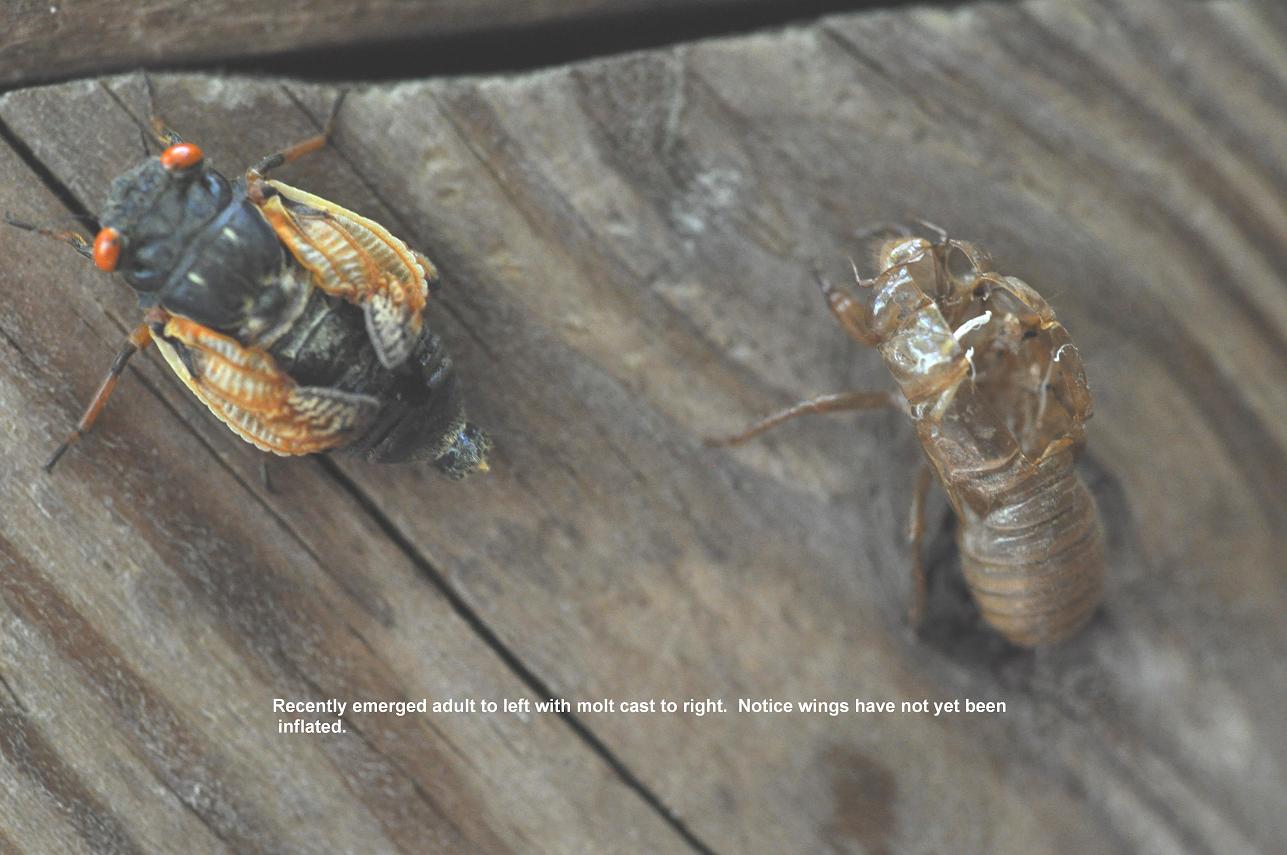
Marian and I had a pleasant surprise this past Sunday morning (May 8, 2011).   During breakfast in our sunroom, we noticed about a dozen little cicadas, outside, sitting on the deck’s banasters and chairs, drying their wings. Nearby, were the nymphal exoskeletons these bugs left behind after molting into the adult stage.  

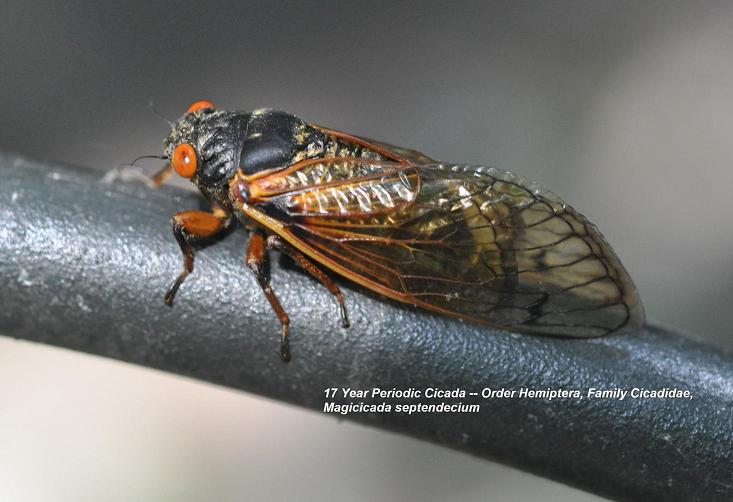
Seeing these insects hit me as strange, because cicadas are the noisy harbangers of late summer—and it’s only mid-Spring.  And these guys were not the bombastic green bugs we hear and see in August and September.  Instead, they were attractive little creatures of about 1.0-1.2 inches long with brownish-gold wings streching away from a gnarly black thorax and a pair of large cherry-red eyes. 

Then it dawned on me.  I had seen this species of cicada before, in the spring of 1994.  There were hundreds covering the trees in a yard of a house I previously owned on the south side of Huntsville, Alabama.  Back then, I did what any field biologist would do.  I collected a bunch, identified the critters and showed them to my invertebrate zoology class.

“I’ve seen this happen before,” I yelled, “seventeen years ago.  By golly!  What we’re seeing is the emergence of the periodic 17-year cicada, Magicicada septendecium.  Get the cameras.  This won’t happen again until 2028.”

Unlike the big 13-year and non-perodic green cicadas that vibrate our eardrums on late summer evenings, this species lives 99.9% of its life as a nymph 10 inches underground for seventeen year, feeding on the juices of plant roots.  When the nymphs fully developed, they wait until the ground temperature at the depth they resides reaches around 63o F, then they burrows their way to the surface enmass—the entire brood in an area (hundreds and sometimes thousands of them) emerges within a day or two. 

Nymphs dig an escape tunnel of about a quarter inch in diameter and crawl out onto the surface of the ground.  Then climb up some nearby prominence and molt.  After exiting their nymphal exoskeleton, the nymphs amble to a safe place safe and dry their bodies and inflate the wings—a process that takes about two hours.   The adult cicadas then fly into the trees where they mate.  

To attract females, the males “sing.”  Their song is loud and intense.  Receptive female respond by flapping their wings in time with the males’ chorus.  Females usually mate once, but multiple matings with a single female does occur.  After mating the female cuts a slit in a young tree branch and lays about twenty eggs.  She does this several time, laying a total of about 600-700 eggs.  After mating adult males and females die.  The entire adult portion of the 17-year cicada lasts about ten days to two weeks.  By the end of June the forests around Hunsville quiet down.  Only the subtle songs of birds, and the chirps of crickets and kadydids touch our ears.

Cicada eggs hatch in about six to ten weeks.  Newly hatched nymphs, which are about the size of a pinhead, drop to the ground and burrow in.  They will grow in the subterrian habitat and reemerge again in seventeen years.

© Richard Modlin 2011

Posted by: Sand Squiggles -- Richard Modlin's Blog | April 13, 2011

Newfound Freedom, Synopsis

Synopsis of My New Novel, Newfound Freedom

Newfound Freedom tells the story of two English brothers, who experience a perilous Atlantic crossing and are unexpectedly drawn into the beginning of the American Revolution.

At the end of May 1773, Ian Hollister graduates from Cambridge University and is offered a position in the family business Boston office.  He requests that his younger brother, Jack, accompany him.  Edward Hollister, the boys’ father, concurs.  In May 1774 the boys depart aboard the family owned brigantine.  A storm forces a leak in the hull.  The vessel limps into Halifax.  Jack and Ian find passage aboard another vessel.

While in a pub in Halifax, Jack observes several redcoats harassing an old man.  He apologizes to the man for the actions of his countrymen.  Captain Hargrave gives the boys passage aboard his schooner Pegasus carrying guns and ammunition to colonial rebels.  The vessel departs ahead of an approaching hurricane.  Jack receives training in seamanship by Charles Bowden and Horace Smoke.  Ian remains below, seasick. 

Ian warns of traveling with rebellious colonials.  Jack advocates for the colonials. 

The hurricane catches up; washes Hargrave overboard, injures Bowden, and smashes Pegasus against the coast of Maine.  Survivors make camp in a protected cove.  Bowden, familiar with the location, warns of resident pirates and wreckers.

Unbeknown to the survivors, HMS Buzzard, a naval frigate commanded by William Francklin, plies the waters off Maine.  He uses the Pegasus for gunnery practice.  Seeing men aboard the wreck, the frigate leaves and sails into Passamaquoddy Bay.  Francklin dispatches marines to capture the survivors.

Meanwhile, the pirate, Dunkin raids the survivor camp.  Dunkin befriends Bowden and moves everyone to the pirates’ camp.  Bowden is reunited with the infamous female pirate Maire Balch. 

Jack enjoys the adventure.  Ian voices concern about their safety.  He becomes enamored with Maire’s younger sister, Kara. 

The marines find and raid Balch Camp.  Ian, Kara, and all able-bodied men are taken prisoner and impressed into naval service. 

Away during the redcoat raid, Jack and others return to find their camp devastated and two men dead.  They escape to Machias, Maine, a logging town composed primarily of colonial rebels.

The HMS Buzzard departs for Quebec. Sidetracked, the vessel overwinters in Halifax.  Being impressed causes Ian depression and disheartenment.  An accident places him and the youngest midshipman together.  Captain Francklin learns that his civilian scout, Jacob Wrack, has an attraction for young midshipmen. 

Although safe in Machias, Jack has bouts of despondency.  He misses his brother, grieves the loss of friends, and is concerned about his uncertain future.  With Ian missing, he would inherit the operation of the family business.  This he doesn’t want. 

As spring 1775 approaches tensions heighten from lack of food, exasperation with Britain, and the battles at Lexington and Concord.  Protected by the Royal Navy, a Loyalist merchant’s attempt to coerce residents leads to insurrection.  Machias leaders strategize a means to combat Loyalist’s attempt.  A naval battle ensues. The militia captures the HMS Maragaretta, kills the captain, and imprisons the crew.  One of Jack’s friends is killed.  Jack and a close friend are injured.  After the battle Jack and Bowden are transported to Beverly, Massachusetts.  

Aboard the Buzzard, Ian, in his attempt to protect the young midshipman, has a confrontation with Jacob Wrack.  When faced with the anger of other crewmen, Wrack jumps overboard and disappears.

Ian, in his foiled attempt to jump ship, is imprisoned.

Wrack reappears in Halifax to murder the Buzzard’s master gunner, and disappears yet again. 

Frustrated, Francklin attempts to depart Halifax, but the HMS Warwick and two frigates detain him.  Fleet command orders the Buzzard back to Boston through a communiqué brought along with a message identifying Ian as one of the missing Hollister brothers.  Francklin delivers Ian to the Hollister House in Boston.

In a pub Jack meets Bowden’s old friend José Diaz.  They depart for Cambridge.  In route, a redcoat patrol confronts them.  Diaz’s men dispatch the patrol.  Jack has an audience with General Washington, who introduces him to Lieutenant Nathan Hale.  Hale stealthily escorts Jack into Boston.  

Reunited with Ian, Jack learns that his father has terminated the North American operation and ordered all associates—including him—to return to England.  Jack appreciates the colonials’ desire for freedom and wants to stay and join them.  With Ian and his uncles taking charge, Jack knows his role will be superfluous in the family business.  Ian, a staunch loyalist, considers the colonials to be renegade Englishmen with no chance of winning the American Revolution.  He tries to convince his brother to return to England.      

After soul-searching and having a fitful nightmarish night, Jack decides to rejoin Nathan Hale and remain in the colonies.  Departing, Jack turns to his brother and says, “Tell Father I will get to Cambridge, but not the one in England.”

© Richard Modlin, 2011

At this time Newfound Freedom is only in manuscript form.  Additional information and the complete manuscript are available, on request, to literary agents and/or publishers.  Please contact me at richard@richardmodlin.com

Posted by: Sand Squiggles -- Richard Modlin's Blog | March 22, 2011

2011 Alabama Writers’ Conclave

          The Alabama Writers’ Conclave, considered one of the oldest continuously active writers’ society in the United States, is meeting on July 15 — 17, 2011 at the Huntsville Marriott next to the world famous Space and Rocket Center in Huntsville, AL.  This year’s noted faculy will cover mystery writing/finding your voice, poetry, nonfiction, and memoir writing.  So come and join the excitement of aspiring writers and well known published southern writers.  And, the AWC writing contest is still open.  Postmark deadline isn’t until April 20th.  So send in those creative pieces.  The opportunity still exists to win one of the four place prizes or the three honorable mentions.  For information visit the AWC website at www.alabamawritersconclave.org.

Posted by: Sand Squiggles -- Richard Modlin's Blog | March 10, 2011

HMAV Bounty

ABOARD THE HMAV BOUNTY

Last October on a cool, breezy, partly cloudy day I walked to the end of a long pier that jutted seaward from St. Andrews, New Brunswick and stepped aboard the Her Majesty’s Armed Vessel Bounty.  The step took me to a time long gone.  But this wasn’t the real Bounty, because according to history and Hollywood, Fletcher Christian and his band of romanticized mutineers torched the original vessel off Pitcairn Island 220 years ago.  This modern HMAV Bounty was built in 1962…

Read the entire article and view photo by going to my website, http://www.richardmodlin.com/?page_id=141

Posted by: Sand Squiggles -- Richard Modlin's Blog | September 28, 2010

Blackflies: A Boon to the Economy

BLACKFLIES:  A BOON TO THE ECONOMY

Recently I became a supporter of the Blackfly Breeders Association (BFBA) by buying a couple of bookmarks the association sells.  It’s the little I can do to support a very simple, but possibly complex, ecological cycle that has great economic ramifications. 

As my friends in Maine and throughout New England say, “…a terrible early summer pest. The blackfly is a minor, but very important contribution to the livelihood of this part of America.”

Basically, this cycle was described to me as follows:  A fisherman feeds on trout—a trout feeds on blackflies.  And blackfies feed on fishermen. 

Though fishermen swat, curse, and yell at the pesky flies with razor sharp mandibles that remove pin-sized chunks of skin dipped in several drops of blood, they continue to ply the pristine streams and ponds, whipping their rods and slinging their lures, in the quest for bass, trout, and salmon.  So strong is this desire to bag these provocative and tantalizing fish that fishermen annually spend hundreds of dollars on equipment, travel, lodging, fishing guides, Cortaid®, food, and alcoholic tinged beverages—the latter, a necessary and important medicinal commodity, drunk in abundance, to recall the catch and assist the action of the unctuous salve.

To get an idea of just how important the blackfly is to a community, I asked a local McDonald’s® cashier what her thoughts were on the subject.  “Aye, she said.  Those fishing guys spend oodles of bucks on Big Macs® and such.”

A similar question asked of the bartender at a not so local tavern, garnered this reply: “Aye, when the trout ‘s a runnin’, those boys really get themselves foo-tified far action.  Then, returnin’ after a good day a wadin’ in the streams, they’re back tellin’ their stories.  The longer they stay, the more they drink, the taller come their tales, and the harder they scratch.”  He nodded his head, poured me another ale, and continued.  “Blackflies’s good for business.”

On the street I asked the town’s noted financier, “If the blackfly is such a boon to the economy, why not promote the mosquito to the same extent?  Trout feed on them too, you know.”

“Well, sir,” he said.  “Folks about these parts hate the mosquita!”

— ∫ ∫ ∫ —

© Richard Modlin 2010

Posted by: Sand Squiggles -- Richard Modlin's Blog | July 29, 2010

Alalitcom

The 2010 Internet Literary Journal, Alalitcom, published by the Alabama Writers’ Conclave is now online.  It can be accessed by visiting www.alalit.com.  Please visit my announcement page for more information.

Posted by: Sand Squiggles -- Richard Modlin's Blog | July 29, 2010

Blue Highways 1


Blue Highways 1:  Huntsville, Alabama to Kelly’s Island, Ohio

Let me share a trip my wife and I took a few years back, where I stay on back roads that took us from Huntsville, Alabama to Kelly’s Island, Ohio, a trip of about 800 miles.  Had we driven the Interstates, this trip would have taken ten to twelve hours.  Instead we chose to avoid freeways and large cities in Tennessee, Kentucky, Indiana and Ohio.  In total of fourteen driving hours we arrived at the ferry dock in Marblehead, Ohio on the shores of Lake Erie.  Actual travel time, however, was two days, because we decided to spend a night in a cute town along the way.

Like Columbus, DeSoto, Balboa, Lewis and Clark, and others explorers we discovered many surprising secrets that lie in the land between the Interstates.  

Just across the border in Tennessee and surrounded by beautiful horse farms with miles of attractive fencing, is Shelbyville.  My wife, a horse lover, knows this place well.

About 120 miles north is Hodgenville, Kentucky, the birthplace and boyhood home of Abraham Lincoln.  In the town square we encountered, and were entertained by, several local politicians stumping for reelection—how about that, ol’ time political enthusiasm still filling the air.

A few miles up the road from Hodgenville is Bardstown.  Here the air took on an odor I’ve smelled before—in a saloon.  But in this city the scent is in its purest form.  Bardstown, Kentucky, the Bourbon Capital of the World, is the home of the Oscar Getz Museum of Whiskey History, and the well known Maker’s Mark and Jim Beam Distilleries. 

This capital of fine whiskey is steeped in early American history and stark contrasts. Stark contrast?  Yes, because just before you get to the whiskey capital, you encounter The Abbey of Our Lady of Gethsemani.  This is the oldest functioning monastery in the United States.  It was made famous by the author and monk, Thomas Merton, who lived here back in the mid-1800s.  The present day Trappist Monks are in the Order of the Cistercians of Strict Observance.  They devote their lives to prayer and work, and study the mysteries of the Roman Catholic Church. 

When I passed through Bardstown, I wondered, monks being who they are, if they sampled the city’s famous elixirs?  They must, because the Monks of Gethsemani are known as the Bourbon Fudge Monks.  And, I can assure you they make the finest fudge I’ve ever tasted.

Moving on to the north, we exited the blue highway onto a beltline freeway to circle around Louisville.  Then I drove east a few miles on I-71 to a back road that took us to a precipice above the Ohio River.  Down we went to the only bridge between Louisville and Cincinnati that crossed this famous river. 

Across this bridge is Madison, Indiana, a river port town where you expect to meet Mark Twain strolling down Main Street.  And, where high-water marks on sides of building show levels the Ohio River reached during previous flood stages.  I’m glad I wasn’t here when one of these major inundations occurred.  The high-water mark is located two stories above the porch of the Victorian style café where we stopped for a snack.  The peak of its roof was the only part of this building to be above the waves.

 After lunch, we continued to drive north into Indiana.  The road ran straight for about twenty-five miles, paralleling a military base where herds of deer ate peacefully behind a chain-linked fence topped with razor wire.  After crossing under several east-west freeways, we arrived that evening in Greensburg, where we stayed overnight.  

Greensburg, Indiana is where a twisted cedar tree grows atop the cupola of the courthouse, 110 feet above the city’s square.  This anomaly is visible from a few blocks away and becomes more difficult to see as one nears.  As we passed next to the courthouse—I wondered if anyone ever trims the tree.  It didn’t appear so.  Our necks strained and twisted from trying to get a good look at the tree, we continued on to Portland. 

Between Portland and Geneva, Indiana the highway contains lanes, which accommodate Amish buggies. 

A fascinating culture, the Amish are a people who live close to the land and without modern conveniences.  Along the highway their well-kept farms had a subtle absence—no power lines connecting them to the infamous national power grid. 

We stopped to enjoy this culture at Amishville, which is located roughly halfway between Portland and Geneva and well off the main road, a sort of Amish Knott’s Berry Farm.  To find it just follow the signs along the buggy lane.

Approaching Geneva, the highway passes through a portion of the Limberlost Swamp, a wetland made famous through the writings of naturalist Gene Stratton-Porter.  Her home, now a museum, is in the city of Geneva.  

Up the road a few miles is the city of Berne, where a beguiling Swiss ambience met us.  Chalet-styled facades, from which flapped colorful flags, tried to entice travelers to alpine splendors and tasty chocolate.  Chocolate they had, mountains?  This is the flatland of Indiana. 

Soon we shot east passed the manicured farms of western Ohio, Heidelberg College in Tiffin, and the Hayes Presidential Center in Fremont.  Then north again to Marblehead, where we stopped at Cheesehaven, our favorite fournisseur de fromage.  After purchasing some delectable cheeses, and groceries and supplies at the local Walmart, we drove the short distance to the pier and caught the ferry to Kelly’s Island.

 —∫∫∫—

© Richard Modlin, 2010
Posted by: Sand Squiggles -- Richard Modlin's Blog | July 10, 2010

Alabama Writers’ Conclave

             The Alabama Writers’ Conclave is considered to be the oldest continuously active writers’ society in the United States.  Its Annual Meeting  will take place 16 — 18 July 2010 at the Birmingham Hilton Perimeter Park Hotel in Birmingham, Alabama.  Please go to my announcement page to read a press release that highlights this meeting. 

####

Posted by: Sand Squiggles -- Richard Modlin's Blog | July 6, 2010

Where I Learn to Hone My Writings

     Like a cowboy, tending a herd of cattle, a creative writer must learn to rope unruly and feral words and bring them into the drove.  Otherwise, whatever he or she is writing will not create the hook that captures the reader or, in the case of an aspiring writer desiring to be published, a publisher and/or agent.  Techniques to accomplish this come from successful authors, who have learn the craft and are able to teach others.

     I’ve been writing for quit a few years and have had a few creative pieces published, but I still consider myself a writer in the mode of learning the craft.  Though I’ve attended college and received several graduate degrees, the knowledge I gathered didn’t give me what I needed to be a creative writer.  It geared me to a career in research and sharing my esoteric findings by writing and publishing my results in scientific journals.  Few people, beyond the scientists interested in my limited little corner of science, read my stuff.  Why, because this form of print is dry and succinct — only the facts, ma’am, only the facts.

     Writings that interest the masses need to be entertaining, instill emotion, and stimulate the senses in addition to relating the facts.  These are the qualities in a piece that a creative writer needs to perfect and sharpen.  One learns and hones these qualities by writing, reading, and listening. 

     “I’ve heard this all before; so what’s the big deal?”  You say.

     It’s the latter activity, listening. 

     “To whom?”

     “Successful writers.” 

     I’ve learned to make my writings more interesting, entertaining, intense, acute, and effective by listening to writers who relate their experiences and knowledge at writers’ workshops where they teach in their specific genre: fiction, nonfiction, poetry, screen writing, children’s writing, etc.  These workshop are usually part of the agenda of a weekend conference of a well established regional or state writers’ organization.  The meetings are usually over a weekend and the teaching faculty are published and well known in their genre. 

      In the very near future I’m attending the 2010 Conference of the Alabama Writers’ Conclave.  And, while there, I plan to pick the fruits that will flavor my scribbling even more.  This conference has four writers’ workshop: short story/screen writing, poetry, creative nonfiction, and children’s writing.  Respectively, the slate of notable authors presenting their knowledge and experiences are Thomas Lakeman, Susan Luther, Kathy Rhodes, and Jo Kittinger.  “What a fabulous group.”  And the conference is also featuring Sonny Brewer, the author of Poet of Tolsey Park, as the Writer-in-Residence. 

     What an opportunity to meet and learn for such a distinguish staff of writers.  If you are an aspiring writer or have any interest in the craft you should attend.  Information on the Alabama Writers Conclave and its conference can be had by visiting the website, http://www.alabamawritersconclave.org.

∫∫∫∫

© Richard Modlin, 2010

« Newer Posts - Older Posts »

Categories