Posted by: Sand Squiggles -- Richard Modlin's Blog | May 28, 2012

MODLIN’S ORANGE MARMALADE

        An ornamental orange tree my wife Marian bought has been growing in and out of our house for the past 20+ years.  Last year, for the first time, it produced about 24 little oranges.  They were inedible, more sour than a lemon and very bitter, but they had the strongest orangy, citrusy smell of any orange I’ve ever encountered.  I have since learned that these oranges (better know across the Atlantic as Seville Oranges) are grown in Spain, Italy, the south of France and other warm places as decoratives and the fruit they produce sold to flavor Grand Marnier, perfumes, soaps, lotions and other things.  But, the British, in their quest to create the finest flavored jam, use these little oranges to make marmalade.  Since I love English marmalade and, not wanting to waste these beautiful fruits, I harvested ours and attempted to convert them to Orange Marmalade.  My endeavor was totally successful.  There is no place in the USA where one can buy a maralade with such a fantastic flavor.  Since I promised my friends, who have tasted my marmalade, to divulge the recipe, it is below. 
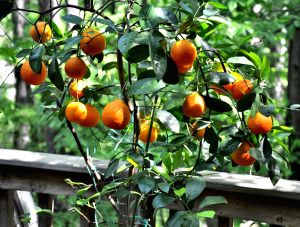
Potted Bitter Orange Tree Growing on Deck.

Ingredients

10 – 14 Bitter oranges (depending on size). Commercially these oranges are difficult to obtain, but are know as Seville Oranges. They are common in Europe (Italy, Spain, and the south of France), but can be obtained in the USA.

2 moderately sized lemons (Meyer Lemon have the best flavor for marmalade, but regular lemons will work.  Luckily, Marian also has one of these growing on the deck.  It has produced fruit for the past 8 or 10 years.)

6 cups of sugar.  This quantity of sugar, sweetens, but maintains the strong bitterness of the marmalade. (Additional sugar can be added if additional sweetness is desired.)

8 cups of water

1 pack of Sure-Jell®

Cooking equipment

4 – 8 quart pan with lid

Ladle

Dipper

Candy thermometer

Sharp knife

12 cup-sized or 8 oz. jelly jars with screw and inner lids. (See below)

Non-absorbing cutting board

A small dish or saucer.

Tongs sufficient to grab and hold jelly jar

Oven mitts or gloves

A medium-sized bowl
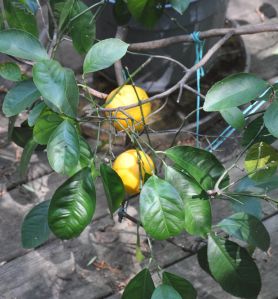
Potted Meyer Lemons Growing on Deck

Procedure

Wash fruit. Do not peel. Remove stem connection. Taking one fruit at a time, cut each in half and then slice each half in thin slices. Cut large end pieces (these will be mostly skin) into smaller ones. Remove seeds from the many semi-circular pieces as best you can. (When the half orange and lemon chunks are thinly sliced, some of the juice of the fruit will ooze out, Try not to lose this juice.) Cut all slices, except the large end, which you have already chopped into smaller chunks, in half. Dump the slices and accumulated juice into the large pan. Once all the slices are in the pan, pour in the 8 cups of water. Stir, cover the pan, and bring to boil over medium heat. Once mixture is boiling, reduce heat. Allow mixture to simmer for 30 minutes, periodically stirring. Turn off heat. Pour in sugar while stirring mixture. Continue stirring for about two minutes to insure all sugar is dissolved. Cover mixture, allow to cool to room temperature, and let stand at room temperature for 18 – 24 hours.

Upon completing the mellowing period, lightly stir the mixture. The few seeds of the oranges and lemons that were not removed earlier will float to the surface and can be carefully scooped out and discarded.

Put small dish or saucer in the freezer. Prepare Jelly Jars (see below).

Again bring mixture to boil, stirring periodically. Once boiling, reduce heat to medium, sufficient to maintain a slow boil, and allow mixture to cook uncovered for two hours, stirring occasionally. After 2 hours, using the candy thermometer, measure temperature of mixture. It should be near or between 220o F and 222o F. (For best jelling results the temperature should be 221o F). Temperature should not be allowed to go above 224o F, otherwise marmalade will taste burnt. Continue cooking until proper temperature is achieved..

When proper temperature is reached, dissolve packet of Sure-Jell, i.e., mix Sure-Jell in a 2/3 cup mixture of water and cooking marmalade (about 1:1). While simmering and stirring the marmalade, pour in the Sure-Jell solution. Continue cooking and stirring for 5 or 10 minutes or more – depends on temp of marmalade mixture. Mixture will slightly thicken — check temperature.  Ladle up a few drops of mixture and drip onto frozen dish. The puddle of mixture should gel and, when touched, form wrinkles on its surface and when dish is turned vertically, the puddle will not run down. If the gel tests work the marmalade is ready to be ladled into the jelly jars for storage.

Carefully, using tongs and oven mitts, remove a jar from the oven and ladle a quantity of marmalade into a jar. Hint: Best to put jar in a bowl while filling to catch spills. Fill to within 1/4 inch of top. Remove an inner lid from the oven and place over the mouth of the jar, then secure it with an outer screw lid. Tighten the lid and put jar aside. Fill the others. Allow jars of cool at room temperature. When you hear the inner lids ping, the jar is sealed. Tapping the top of the inner lid after the jar have cooled.  A solid thud indicates the jars have totally sealed and can be stored in a pantry for later use. Bon appétit.

Sterilization of Jelly Jars and lids

Wash jars and inner lids in dishwasher. Arrange washed jars on towel paper, open end down. Do likewise with inner lids (inside of lid should be face down). Prior to ladling mixture into jars, put jars (mouth of jar up) and inner lids (inner side up) on a cookie sheet or suitable oven-proof tray and into an oven for at least 15 min at 250 – 275o F. Keep everything hot until ready to use.

© 2012 Richard Modlin
Posted by: Sand Squiggles -- Richard Modlin's Blog | March 22, 2012

RESEARCH AND THE CREATIVE WRITER

In preparing a talk I gave recently I learned that the subject of research, when it falls under the purview of creative writing, could be approached from three perspectives:  (1) Intentional Research, when the writer is searching directly for information to satisfy the needs of a specific, usually ongoing project; (2) Inspirational Research, when the attempt is to learn, create or experience knowledge that could provoke an image, idea, or connection, which may inspire an article, story or poem; and (3) Fortuitous Research, where the writer has an unplanned experience that stimulates an idea or provides material for a story, article, or poem written later. 

Intentional Research is very familiar to writers—or should be.  We pencil in a fact, an unusual word, a scene, a character’s description when creating the framework of our piece, but are the details accurate and/or proper?  Was the dialogue I wrote for my character actually part of his lexicon?  Were there any blue daffodils in Shakespeare’s garden?  Did Shakespeare have a garden?  Are there any blue daffodils?  Was the rogue that was slinking down an eighteenth century wharf wearing a decorous outfit?  Does a flamingo feed with its head upright or upside down?  The details of this latter question James Audubon overlooked, when he painted his famous drawing of a feeding flamingo. Ol’ James didn’t do his research. 

These are the kinds of inquiries writers encounter.  To gain answers, they hit libraries, surf the Internet, visit museums, battlegrounds or other relevant locations, do interviews, or perform experiments.  They gather the information with the intent of providing credibility to their project.

One of the beauties of Intentional Research is that the writer will in most cases learn something new; find a quirk that may add humor, sadness, or other sensual or visual stimuli.  These deviations from the norm provide anecdotal material, which adds color to writing and enhances its appeal.  Thus Intentional Research blends into Inspirational Research, because this newfound material provides fodder for other writings.

Inspirational Research has always supplied me with a wealth of material.  Thankfully, I kept a journal while traveling around Kenya and the Seychelles.  Ten years after the trip, my notes, photographs, and the knickknacks that I collected provided the material to write my travel adventure Malachite Lion.  Likewise, my bird watching journals, notes and travels supplied information for my recent book, Chasing Wings.

So how does the third method, Fortuitous Research, of gathering knowledge benefit a creative writer?  Let’s say a writer and his friend are ice fishing, the ice breaks and they fall in.  If the writer doesn’t freeze or drown, he may someday create a character that falls through the ice.  He will be able to describe the experience accurately, if the writer had kept alert, an open mind, and stayed observant during his unplanned encounter to mimic a polar bear. 

Of the three methods of inquiry, I find Inspirational Research the most enjoyable.  I’m always prodding my muse and her toys for ideas. 

One of the best ways I found to utilize all three methods of research in one weekend is to attend a writers’ conference.  This summer the Alabama Writers’ Conclave, one of the oldest continuously operating, and most nurturing, writers’ organizations in the USA, is holding its annual event at the Huntsville Marriott, a hotel next to the U. S. Space and Rocket Center.  Besides meeting writers, attending workshops, networking and socializing, I am sure a view of a full-sized space shuttle, Apollo and Saturn 5 rockets, and the variety of other space flight paraphernalia will provide a wealth of information and inspire in me gallons of creative juices.

– ∫ ∫ ∫ ∫ –

© Richard Modlin 2012


Posted by: Sand Squiggles -- Richard Modlin's Blog | March 7, 2012

2012 Daddy’s Girls’ Weekend

Writers’ Event in April, 2012, in Mobile, Alabama

Dr. Sue Brannan Walker, the Poet Laureate of the State of Alabama, would like to let creative writers know of this up coming exciting and informative event.  

Two of Alabama’s finest writers are teaching workshops at the 2012 Daddy’s Girls’ Weekend in Mobile, Alabama in April. They are just a part of a truly wonderful opportunity available at this readers’ and writers’ conference.

The conference is the brainchild of Carolyn Haines, the 2010 Harper Lee Award winner as Alabama’s Distinguished Writer of the Year.

Sue Brannan Walker, Alabama Poet Laureate, is teaching the workshop “Writing Big Daddy.” As an outgrowth of the competition among the male faculty to be crowned “Big Daddy” at the workshop, Sue’s workshop will explore the concept of Daddy as story, verse and flash drama.

The rest of the workshops are filled out with such luminaries as Dean James, a New York Times Bestselling author with the “Cat in the Stacks” books, Urban Fantasy author Anton Strout, Paranormal Romance author Deborah LeBlanc, agent Marian Young, Penguin editor Michelle Vega, and Tyrus Books Publisher Benjamin LeRoy.

Workshops include “The Organic Growth of Southern Character” with Carolyn Haines, the “Author/Editor relationship with Dean James and Michelle Vega, and a panel on e-publishing with all members of the faculty.

Join us at the historic Malaga Inn in downtown Mobile for a weekend of inspiration and entertainment.

For more information please see the Daddy’s Girls’ Weekend website:

http://www.daddysgirlsweekend.com, or contact workshop administrator Sarah Bewley by e-mail dgweekend@gmail.com or by phone 917-226-2588.

Posted by: Sand Squiggles -- Richard Modlin's Blog | January 6, 2012

Birding Florida’s Space Coast


An Afternoon Along Black Point Wildlife Drive


One of the pleasures of visiting the Cocoa Beach/Cape Canaveral area in Florida in winter is to go birding and see many species of local birds and those that come here for the climate.  All along the Indian River, Banana River, Sykes Creek, the coastal beaches and Merritt Island are parks, where one can stop, relax and look for unusual avian species. 


Probably the best area is the Merritt Island National Wildlife Refuge, which encompasses most of the northern end of Merritt Island.  Although this refuge contains the Kennedy Space Center and Cape Canaveral Air Force base, which are off limits to casual birders, a great portion of the northern extent of this preserve is open to the public.  This area, which is laced with a variety of access trails, is across the Indian River bridge from Titusville.  All habitats north of the Max Brewer Memorial Parkway and Florida Hwy 402, from Indian River to the beaches along the Atlantic Ocean, are available to enjoy bird watching. 

The most exciting and productive of these trails is the Black Point Wildlife Drive, a seven-mile, well developed and maintained automobile road, with pull-offs and parking areas placed at strategic locations.  Off the parking areas are hiking trails of various length.  Lookouts, where one can view activity on isolated ponds and streams, are provided along some trails. 


The road passes through and along palm hammocks, salt marshes, black mangrove swamps, grass and brush meadows, and open-water estuarine and freshwater ponds and streams.  For a nominal fee, bird watchers can spend the entire day exploring the bird habitats along this wildlife drive.  Though the posted speed limit is 15 mph, the average is about 7 mph.  And, with the many stops to observe and photograph bird, the drive takes a minimum of two hours.


Marian and I spent two afternoons along the Black Point Drive observing and photographing birds.  In addition to the pictures of birds I posted, we saw white pelicans, brown pelicans, white ibis, snowy egrets, American egrets, a pair of lesser scaups, wood storks, ospreys, royal terns, herring gulls, ringed-bill gulls, laughing gulls, Bonaparte’s gulls, common gallinules, boat-tailed grackles, a sora, belted kingfisher, scrub jays, palm warblers, yellow-rumps, seaside sparrows, black vultures, turkey vultures, sanderlings, a couple of alligators, and a medium-sized furry mammal that scooted across the road too fast to be identified.  Of greatest abundance were the American coots; there were hundreds of them.  Marian said that they reminded her of the wildebeests on the African grasslands. 


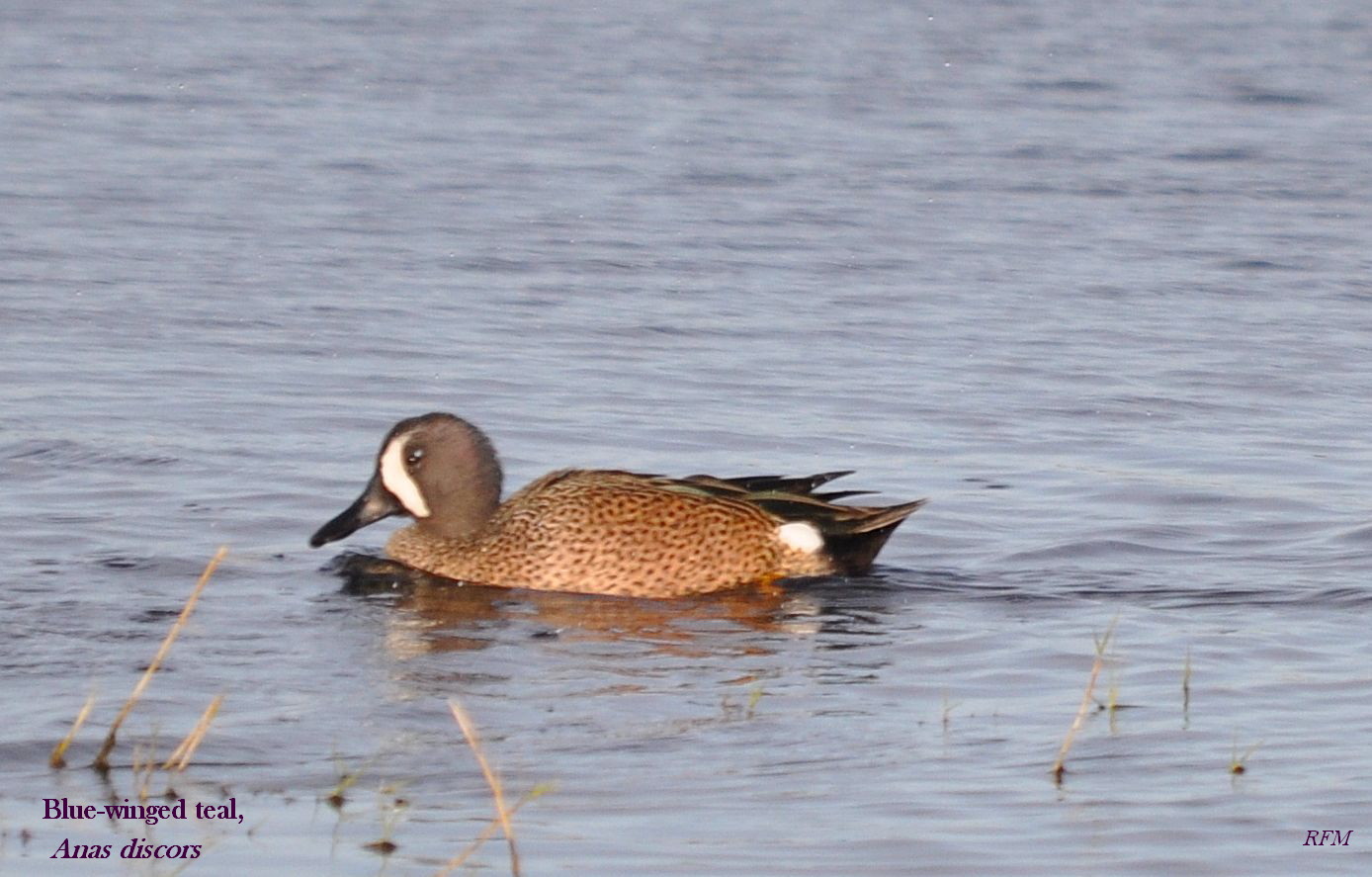
If you find my photos interesting, please let me know what you think of them.   Also please click on “My Books” above and check out the book titled Chasing Wings to read about my other bird watching adventures.   

© Richard Modlin 2012


Posted by: Sand Squiggles -- Richard Modlin's Blog | October 22, 2011

HISTORY IN MACHIAS, MAINE

A Patriot’s Resting Place

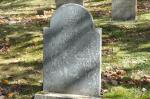
Several days ago, while trying to photograph Roaring Falls, a catarack in the Machias River on the west side of Machias, Maine, I found an interesting historic site.  About one hundred yards downstream of Roaring Falls Park, off a path on the south side of the river and up a forested knoll, I encountered the O’Brien graveyard.  Lying in a copse of very old oak trees along the northern ascent of the hillside were about thirty grave sites peppered with autumn-colored leaves—a peaceful, idyllic place.

O’Brien Tombstones

Lowest on the hill were a row of five stone markers, dating back to the early 19th Century.  A flag flew next to one of these tombstones, marking the brial site of probably Machias’ most distinguish founding fathers, Captain Jeremiah O’Brien.  On the right lay his wife Elizabeth, and on his left Jeremiah’s father, Morris, and mother, Mary.  Writing on tombstone farthest to the right was indistinguishable, perhaps one of Elizabeth and Jeremiah’s children.

Machias, ME, City Center

These gravesites substantiated that the people I wrote about in my recently completed novel, Newfound Freedom (see Sand Squiggle’s blog posted April, 2011), were indeed real, and lived and die where they were suppose to have been.

I knew the O’Briens of Machias existed because their names appear in the history of the city, on old maps, and even on a 18th Century fortification down river.  But actually being in their presence, at least in spirit, was to me an eureka moment—like realizing you had just slept in an inn where George Washington once slept.

Elizabeth O’Brien Tombstone

Well, who were the O’Briens?  They were the founders of West Falls, a village in the township of Mashias, which in the 18th Century was part of Massachusetts.  When this portion of MA was rename the State of Maine, West Falls became City of Machias.  Morris O’Brien and his five sons were prominent lumberers in this city.  Their residences, sawmills and other enterprizes were located on the site of Great Falls Park and they owned the land to the east and south of the park.  But of the five brothers, it was Jeremiah O’Brien who distinguished the family.

Patriot’s Resting Place

On 12 June 1775, under his command, the cargo vessel Unity, which Jeremiah and a band of rebellous patriots armed with variety of guns and primative weapons commandeered.  Using the Unity, they pursued and captured Great Britain’s armed schooner HMS Margaretta.

The Margaretta had escorted two frighters, the Unity and Polly, to Machias to take on lumber for the British Army headquartered in Boston.  Because both of these vessels were own by a Loyalist, who resided in the village, and most of the townspeople were patriots, the captain of the Margaretta threatened to bombard the village if any of the townsfolks interferred in this transaction.  With Concord and Lexington fresh on their minds and their abhorrence of the developing British tyranny in the colonies, the captain’s threat did not sit well with the patriots.  The Battle at Machias, which was fought in Machias Bay, lasted about an hour and became the first naval battle of the American Revolution.

For his part in this conflict, Jeremiah O’Brien was given the rank of captain in the Massachusetts Navy, one of the forerunners of America’s Continental Navy, and eventually the U.S. Navy.  Over the next 200 years the U.S. Navy distinguished O’Brien by christening four destroyers in his name.  But the most famous of the naval vessels that carries his name is the SS Jeremiah O’Brien, the last authentic Liberty Ship still in full operation.

Docked at San Francisco’s Fishermen’s wharf, the Jeremiah O’Brien is open to the public and cruises the bay area.  It is itself a distinguished WWII naval vessel.  During the war it sailed throughout the Atlantic and Pacific and aided in the Invasion at Normandy.  On one of her trips to Normandy she transported General Patton’s Fifth Division.  She recently returned to Normandy to celebrate the 50th anniversary of this D-Day Invasion—the only authentic WWII naval vessel to attend this ceremony.

Others buried in the O’Brien cemetery, in addition to relatives and inlaws, are Captain O’Brien’s brother, Gideon and his family, as will as the captain’s son, Jeremiah O’Brien and his family.  The second Jeremiah O’Brien, born in 1778 and died in 1851, also distinguished the family.  Captain O’Brien’s son was elected to the Maine State Senate in 1821 and served until 1824, when he became a U.S. Congressman in 1823.  He represented the State of Maine until 1829.  While in the U.S. Congress he served on the Committee on Expenditure in the Department of Navy.  After his stint representing the State of Maine in congress, he served two more terms in the state senate and then, he returned to the family’s lumber business.

– ∫ ∫ ∫ ∫ –

© Copyright Richard Modlin 2011
Posted by: Sand Squiggles -- Richard Modlin's Blog | October 15, 2011

IMPRESSIONS ON WILD WATERS 2

The Nesowadnehunk Stream to the North

At least it’s not raining, but the sixty-foot tall, black-green fir trees at the edge of the yard stand like silhouettes against the blanched curtain hiding the bay.  You would think the day would be great for ducks, but it’s the crows that are having their convention.  One flies to a fir tree and lights on the tip branch, the single, thin bough that creates the peg upon which a star, angel or dove are placed at Christmas time.  Soon others, four to six of them, land on the surrounding topmost horizontal branches.  These stems are also thin and bend under the weight of the crow.  The crows bobble and caw, then fly off, like flapping black clothes, in all direction and disappear into the white featureless fog.  They’ll return in about ten minutes—but enough about crows. 

Bridge over the Nesowadnehuck

This post is about the northern stretch of the Nesowadnehuck Stream flowing on the west side of Katahdin through Baxter State Park, ME.

The gravel Tote Road that traverses Baxter from the Visitors Center at Togue Pond Gate, the park’s southern entrance, to Matagamon Gate, the northern entrance, parallels the Nesowadnehuck from Foster Field-Kidney Pond Camps to Nesowadnehuck Field Camp.  Since this is distance is about eight miles, and it was already after lunch, we decided to drive, wanting to return to our campground before dark.

Kidney Pond Library

After a short visit to Kidney Pond Campground, a more manicured camp with rustic cabins than the one on Daicey Pond, we connected with the Tote Road at Foster Field, a picnic area and primitive camping site.  The spectacular steep face of O-J-I Mountain (height 3434 feet) can be seen from the picnic area.  The name of this mountain came from past rock slides that carved the initials into this landmass. 

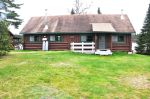
Camper's Cabin at Kidney Pond

From Foster Field the Tote Road runs along the base of O-J-I Mountain and periodically comes into the shadow of this mountain’s second, lower West Peak (height 2502 feet).  The fir-birch forest occasionally opens and the road dust clears, providing a view of West Peak and the mountain’s initials.

About a mile up Tote Road, on the left, is the grave of the unknown River Driver.  These were the sure-footed, hearty, crazed men that waltzed about the logs that were cut in the winter and floated down the raging Nesowadnehuck to the Penobscot River sawmills in the spring.  River Drivers are pictured wearing felt hats and carry long poles, which they use for balance, redirecting stray logs, and breaking jams.  A missed step, ricocheted push, or a collision, while driving rolling logs down a highballing, whitewater streams, sends the driver into the cold, churning foam.  The felt hat, found swirling in an eddy, signified another of these gandy dancers had met his demise.

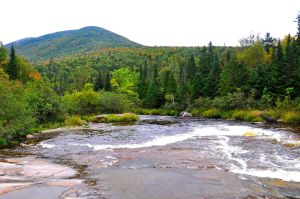
Slide Dam area on the Nesowadnehuck Stream

Two miles ahead is the Slide Dam, where the Nesowadnehuck spills, slides, and glides, and turns, twists and swirls over smooth, flat granite slabs down a thirty-foot gradient of about a quarter mile in length.  It’s as if one could easily surfboard or snowboard down this slide.  I did so in similar stretch of a mountain stream in western Belize, but without any board.  The butt of my bathing trunks got a bit worn. 

Slide Dam on the Nesowadnehuck Stream in Baxter State Park, ME

Plein air artists and sketchers of postcard scenes are drawn to the Nesowadnehuck Slide because of its idyllic beauty and color.  This place glows in the autumnal colors of reds, yellows, purples, browns, beiges and greens.  The dark green of the firs, maple reds and shimmering yellow birches contrast the purples and violets of the surrounding mountains.  Clumps of asters and sunflowers, fresh and dried sedges, grass and alders trim the shoreline of the pewter bottomed, eager flowing stream.

Upstream of the slide about three quarters of a mile, the Nesowadnehuck crashes down Ledge Falls.  Here the beauty brackets an angry stream.  Two miles farther upstream, the Nesowadnehuck narrows and meanders serenely toward its headwaters outside the state park. 

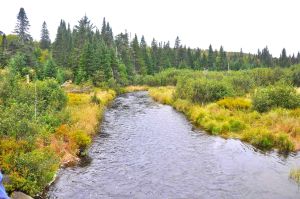
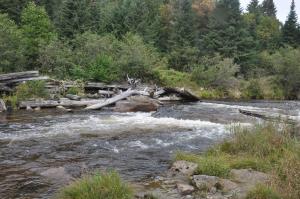
The Nesowadnehuck Stream Looking Downstream from bridge.

We had reached Nesowadnehuck Field Campground, a desolate area near the western boundary of Baxter State Park, containing a picnic area and primitive tenting site.  I stood on a bridge crossing the stream, wondering how big the brook trout were that swam below.  Atop a straggly fir an American kestrel perused the landscape and a Philadelphia vireo flitted to another tree.  Sunlight waned.  We turned for Daicey Pond Campground and returned in time to toast a rising full moon with a glass of wine and hear the kindling in the fire pit begin to crackle. 

The Nesowadnehuck Stream Looking Upstream from Bridge

– ∫ ∫ ∫ ∫ –

 © Copyright Richard Modlin 2011
Posted by: Sand Squiggles -- Richard Modlin's Blog | October 9, 2011

IMPRESSIONS ON WILD WATERS


The Nesowadnehunk Stream Going South

Rivulets of rainwater that stream down the windows create slithering, distorted images of the birch and fir trees, shoreline, bay and the distant horizon outside.  Bleakness and black-green-gray monochromaticity prevail.  That’s what it’s all about in northern Maine. From the Downeast coast to the Canadian border water and rock, sphagnum and reindeer moss, conifers, and deciduous trees with trunks wrapped in peeling bark typify this environment; but water is the most important characteristic.

Besides the ocean that bathes the magnificent, spectacular rocky Downeast coastline, there is a patchwork of natural and manmade lakes, bogs, beaver ponds, and the tributaries that connect them strewn across the interior.  These are quiet, picturesque places where the call of the loon echoes in the evening.

But it’s the streams, rivulets and rivers that are the most sensational.  They whisper, babble, and roar.  Their flow meanders, ripples, runs and falls in colors of black, amber, and clear; the latter, if viewed from another angle, reflecting the sky.  In some places these watery paths and roadways cascade in anger, spouting routs of foam and mist.

The Nesowadnehunk Stream near, but above Little Niagara Falls, Baxter State Park, ME

A short distance (about a quarter mile) from the cabin at Daicey Pond Campground (DPC) in Baxter State Park, ME, flows the Nesowadnehunk Stream.  The stream flows south, through Baxter along the western side of Katahdin, from the about ten miles north to park’s southern border, where it pours into the Nesowadnehunk Deadwater area, a region of connecting marshes, ponds and bogs.  This region eventually forms the headwaters of the Penobscot River. 

In the state park, the Appalachian Trail (AT) comes in contact with the Nesowadnehunk waterway just north of DPC, follows it southeast to the Penobscot’s headwaters and turns south.  After about three tenths of a mile the AT makes a hard right, crosses the Penobscot at Abol Bridge Campground and continues southwest out of Baxter and toward Springer Mountain, GA.

To discover the essence, history and wildness of Baxter’s endless forest environment and, view the tumultuous nature a stream falling down a mountain side, the first morning my camping buddies, Pierre and Pat, and my wife, Marian, and I hiked south on the AT for little over a mile to Toll Bridge and Little Niagara.  The trail was easy, only a few ascents and descents, boulders to climb over, mud and slippery logs, and exposed ankle twisting roots.  Mushroom, ferns, alder bushes, sprouting balsams, asters, mosses and sphagnum, and lichen covered limbs and rocks littered the resin, musty smelling forest floor.  The stream gurgled somewhere beyond, hidden by the mass of trees.  But as we neared our destination the Nesowadnehuk began to roar. 

An Avatar at Rest

Ahead I saw an AT trail marker.   It pointed to the left at a junction with another trail that went to the right.  Pierre motioned for us to go right. 

This short trail ended on the sandy bank where the Nesowadnehunk, after crashing through and over a driftwood-strewn barrier, churned past as if it were late meeting its deadline with the Penobscot.  During the lumbering heydays of the late 19th and early 20th centuries, a bridge or dam once crossed this portion of the stream.  Remnants of hewn timbers and rusting steel cables lay exposed along the shore.  I wondered whether or not lumberjacks and river drivers had to pay a toll if they wanted to cross.

The Nesowadnehunk Stream flowing over the reminants of the Toll Bridge

The Nesowadnehunk Stream approaching Little Niagara Falls

Not far ahead was the cataract named Little Niagara Falls.  Here the Nesowadnehunk rampaged between and over boulders, and cascaded down about thirty feet in foamy, churning vociferousness.  The roar of the stream was so loud we had to shout to be heard, so we sprawled out on the granite precipice, enjoyed the view, and ate our trail-mix.  Later this afternoon we planned to drive north for more spectacular views of the Nesowadnehunk.  

Precipice of Little Niagara Fall

– ∫ ∫ ∫ ∫ –

© Copyright, Richard Modlin 2011

Posted by: Sand Squiggles -- Richard Modlin's Blog | October 1, 2011

CONTEMPLATIONS ON KATAHDIN


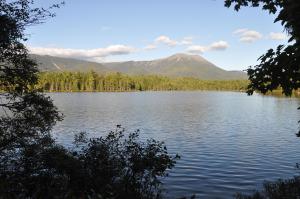
Mt. Katahdin Across Daicey Pond

Some years ago I sat reading Hemingway outside a lounge of an Amboseli resort, a tot of scotch in my hand.  Across the grassland, Mount Kilimanjaro stood three miles in front of me.  Last week, sipping Yorkshire tea, I sat on the porch of a rustic cabin on the west side of Daicey Pond, contemplating the view of another notable mountain, Katahdin.  Like Kilimanjaro, Katahdin stood about three miles away, its pinnacle exposed above the expansive fir forests but not covered in snow.

Katahdin is the centerpiece of Baxter State Park that is located in north central Maine.  Depending on whether you are coming or going, the 5,268-foot summit of Katahdin, known as Baxter Peak, is either the terminus or the head of the famous Appalachian Trail (AT). To fully complete their quest an AT “Thru” hiker (one who treks the entire 2000-plus-mile distance to or from Springer Mountain, GA) must plant his or her feet on Katahdin’s peak. 

I contemplated the challenges Katahdin places on AT “Thru” hikers.  The AT passes through Daicey Pond campground.  From here it is a seven- to twelve-hour trek to the summit, depending on the fitness and stamina of the hiker.  

Clouds atop Katahdin

I met one such hiker on this trip, a young, handsome, healthy-looking fellow from California, as I slogged along a portion of AT that ran next to a roaring river.  He was moving at a near jog.   For the moment he came next to me, he slowed to chitchat and introduce himself as Squatch, his trail name.  He told me that he had hiked several of the long trekking trails in the USA when he came up behind me.  Squatch then hurried ahead and yelled back, “I’m trying to catch up with my girlfriend.”  Since I had not encountered her during my time on the trail, she must have been several hundred yards ahead.  “She jogs on the trail,” I heard him say as he rounded a bend and disappeared among the trees.  Either Squatch got a slow start, I thought, or his woman was a more apt trekker than he.  Though I suspect, his lag behind her was due to his sociable nature and stopping to talk to folks like me along the way.

Whatever, these “Thru” hikers are a diehard bunch, literally.  Yesterday I read in daily news where an AT “Thru” hiker became ill on the trail, but continued on his trek because he was within two miles of reaching his destination, the summit.  Others found him and went for help.  The ill hiker was taken off the slope and to a hospital, where he later died. 

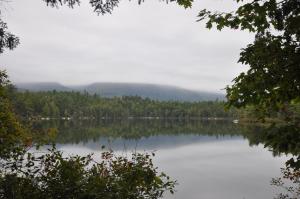
Fog Rolling down Katahdin

Now that’s a do or die attitude.  Once upon a time I may have wanted to travel every byway and climb every mountain, but now I content myself by contemplating the subtleties that take place in challenging and wild places.  Like Kilimanjaro, Katahdin’s image changes with the lighting throughout the day and with meteorological conditions.  These changes are fun to watch and photograph.

Sun Rising Behind Katahdin

∫ ∫ ∫ ∫

© Richard Modlin copyright 2011
Posted by: Sand Squiggles -- Richard Modlin's Blog | July 3, 2011

Sue Brannan Walker, State of Alabama Poet Laureate

The 2011 Alabama Writers’ Conclave is fortunate to have State Poet Laureate, Dr. Sue B. Walker, as a faculty member, leading the conference workshop in Poetry.  Recently Dr. Walker has been asked by the National League of American Pen Women in Washington DC to do a workshop for them in April.  To learn more about Dr. Walker and her credits, please read the more detailed bio posted below. 

In addition to Poetry, workshops in Fiction, Nonfiction, and Memoir are also be held at the upcoming Alabama Writers’ Conclave.  This year the conference is being held in Huntsville, AL, from July 15 – 17 at the Marriott next to the Space and Rocket Center.  For more information visit the AWC website, www.alabamawritersconclave.org.  There is still time to register and not miss out on Dr. Walker’s workshop or any of the others.

Sue Brannan Walker

            Dr. Sue Brannan Walker is Poet Laureate of Alabama, the Stokes Distinguished Professor of Creative Writing and Director of the Stokes Center for Creative Writing, and Professor of English at the University of South Alabama where she teaches courses in creative writing. She and her students are proud of their class poetry projects, namely working with Place 15 in Mobile, Alabama where they teach writing to the Homeless.

            Dr. Walker is a poet, playwright, professor, scholar, author, and Publisher of Negative Capability Press. She has eight published books of poetry, has edited four national literary anthologies, had work published in more than fifteen anthologies, published more that fifty critical articles, and is known for her critical work on Southern writers, Carson McCullers, Flannery O’Connor, and James Dickey.

            Dr. Walker has won the Alabama-Writer’s Conclave Play-Writing competition for her one-woman, one-act play based on the life of Mobile’s Madame Octavia LeVert. She has subsequently performed the play at the Firehouse Theater in Mobile, at Oakleigh, in New Orleans, Gulf Shores, and other local venues.  For her research on Octavia Le Vert, she was awarded an Elizabeth B. Gould Research Award from the Mobile Historic Development Commission.

            Included among Dr. Walker’s awards is the William Crawford Gorgas Award from the Alabama Medical Association for significant work by a lay person in the medical field for Life on the Line: Selections on Words and Healing.  This book also received the Book of the Century Award from the Alabama State Poetry Society.  Dr. Walker has received the Mobile YWCA Woman of Achievement Award and the
Mobile Arts Council Award for Lifetime Achievement in 2006.She was the First Lady of Mobile  in 2006. Dr. Walker publishes in the field of Medical Humanities and has served on the University of South Alabama Medical Admissions Committee. She has served as Chair of the Disabilities Committee for the National Modern Language Association.

            Dr. Walker has been a recipient of an Alabama Council on the Arts Individual Writers Fellowship. Dr. Walker has received a citation from the city of Birmingham for her literary achievements and been honored by Sue Walker Day in Foley, Alabama, has served as President of the Alabama State Poetry Society and the State President of the Alabama National League of American Pen Women, President of the Mobile Chapter of the National League of American Pen Woman, and The Pensters.  She is a member of the Sigma Tau Delta Honor Society, the Golden Key National Honor Society, Phi Kappa Phi Honor Society, and Sigma Tau Delta Honor Society.

            Dr.  Walker has won the Hackney Literary Award for fiction and has published poetry and fiction in more than sixty national journals. Her work as editor and publisher of the literary journal Negative Capability journal was recognized by Writer’s Digest where it was declared the most 3rd prestigious literary journal in United States in the 1990s.

            Faulkner Suite, a collection of poems about William Faulkner was published by Oeonoco Press in 2008. Whatever Remembers Us: An Anthology of Alabama poetry , was a Southern Booksellers Best Poetry Book finalist in 2008.  She is completing a critical book on James Dickey and Deep Ecology, and working on a novel on the yellow fever epidemic in Mobile in 1878.  A book on the Mobile-Tensaw Delta came out in early 2004 from NewSouth Press.

            Dr. Walker is a graduate of the University of Alabama where she received a B.S. degree in Education and Tulane University where she received M.Ed,  M.A. and Ph.D. degrees.

Posted by: Sand Squiggles -- Richard Modlin's Blog | June 18, 2011

Why Attend Writers’ Workshops

   Last year I published the essay below to inform aspiring and successful writers how I learned to hone my writing abilities.  I’ve updated it.

   This year, 2011, The Alabama Writers Conclave is having their conference in my hometown, Huntsville, Alabama.  I’m going to this event and plan to attend workshops that are being taught by well-known writers of fiction, nonfiction, poetry and memoir.  The Conclave is a writer-friendly organization and the workshops are especially aimed at nurturing aspiring writers.   I hope you join me.

Where I Learned to Hone My Writing. 

  Like a cowboy, tending a herd of cattle, a creative writer must learn to rope unruly and feral words and bring them into the drove.  Otherwise, whatever he or she is writing will not create the hook that captures the reader or, in the case of an aspiring writer desiring to be published, a publisher and/or agent.  Techniques to accomplish this come from successful authors, who have learn the craft and are able to teach others.

     I’ve been writing for quit a few years and have had a few creative pieces published, but I still consider myself a writer in the mode of learning the craft.  Though I’ve attended college and received several graduate degrees, the knowledge I gathered didn’t give me what I needed to be a creative writer.  It geared me to a career in research and sharing my esoteric findings by writing and publishing my results in scientific journals.  Few people, beyond the scientists interested in my limited little corner of science, read my stuff.  Why, because this form of print is dry and succinct — only the facts, ma’am, only the facts.

     Writings that interest the masses need to be entertaining, instill emotion, and stimulate the senses in addition to relating the facts.  These are the qualities in a piece that a creative writer needs to perfect and sharpen.  One learns and hones these qualities by writing, reading, and listening. 

     ”I’ve heard this all before; so what’s the big deal?”  You say.

     It’s the latter activity, listening. 

     ”To whom?”

     ”Successful writers.” 

     I’ve learned to make my writings more interesting, entertaining, intense, acute, and effective by listening to writers who relate their experiences and knowledge at writers’ workshops where they teach in their specific genre: fiction, nonfiction, poetry, screen writing, children’s writing, etc.  These workshop are usually part of the agenda of a weekend conference of a well established regional or state writers’ organization.  The meetings are usually over a weekend and the teaching faculty are published and well known in their genre. 

      In the very near future I’m attending the 2011 Conference of the Alabama Writers’ Conclave.  And, while there, I plan to pick the fruits that will flavor my scribbling even more.  This conference has four writers’ workshops: fiction/editing, poetry, nonfiction, and memoir.  Respectively, the slate of notable authors presenting their knowledge and experiences are Chris Roerden, Dr. Sue B. Walker, Jenny Ivey, and Jim Minick.  “What a fabulous group.”  And the conference is also featuring Rabbi Rami Shapiro, the notable inspirational author, as the Writer-in-Residence. 

     What an opportunity to meet and learn from such a distinguish staff of writers.  If you are an aspiring writer or have any interest in the craft you should attend.  Information on the Alabama Writers Conclave and its conference can be had by visiting the website, http://www.alabamawritersconclave.org.

∫∫∫∫

© Richard Modlin, 2011

« Newer Posts - Older Posts »

Categories